
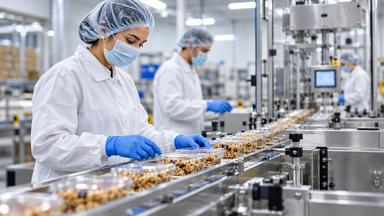
For many consumer-packaged goods brands, the path to an allergen-free claim comes with an important question: If our product is made on equipment that also produces products containing allergens, can we still become certified? The short answer is: potentially, yes.
Producing a product in a shared facility or on shared equipment does not automatically mean an allergen-free claim is out of reach. What matters is whether the manufacturer has effective processes in place to prevent allergen cross-contact and can demonstrate that those processes are working consistently.
That distinction is increasingly important. In the United States, nine foods, and ingredients containing their proteins, are currently defined as major food allergens. They are milk, eggs, fish, crustacean shellfish, tree nuts, peanuts, wheat, soybeans and sesame. These allergens account for the large majority of severe food allergic reactions. For CPG brands looking to better serve consumers managing food allergies, understanding how allergens are controlled throughout production is an important place to start.
Dedicated vs. Shared Equipment
Dedicated equipment can simplify allergen control because it reduces opportunities for an allergen to come into contact with a product during production. But dedicated equipment or an entirely allergen-free facility is not always practical or even necessary.
Shared equipment requires additional controls. Manufacturers need to understand where allergens are present, how they move through the facility, and what needs to happen between production runs to prevent cross-contact. Manufacturers may use dedicated facilities, dedicated equipment or other procedures designed to reduce the risk of allergen cross-contact.
A Strong Process Matters
When equipment is shared, production scheduling can play an important role. Facilities may schedule allergen-free products before products containing certain allergens or structure production runs in a way that reduces the opportunity for cross-contact.
Cleaning is another critical piece. It is not enough to simply have a cleaning procedure written down. Manufacturers need to know that the process effectively removes allergen residue from equipment and production areas. Cleaning validation, routine verification and testing can provide evidence that the controls being used are working as intended.
Testing adds another layer of assurance by helping verify that products meet established requirements. Rather than relying on a single test or point-in-time result, an effective allergen-control program looks at the entire production process and verifies that the testing put in place is effective and sufficient.
Control Allergens Beyond the Production Line
Allergen management does not begin and end with equipment. Ingredients containing allergens should be clearly identified and appropriately segregated during receiving, storage and handling to help prevent accidental use or cross-contact. Employees are just as important. Team members should understand allergen-control procedures, follow established practices for handling ingredients and equipment, and know what is expected before, during and after a production run.
Documentation ties all of these efforts together. Cleaning records, production schedules, ingredient information, testing results, training records and other documentation can help demonstrate that allergen controls are not simply policies on paper; they are being followed consistently.
Certification Is About Verification
For brands exploring an allergen-free claim, a shared production line does not necessarily have to be a deal-breaker. The bigger question is whether the processes surrounding that line can effectively control the allergen and whether those controls can be verified. That verification matters because allergen labeling carries significant responsibility. Federal law requires major food allergens used as ingredients in most packaged foods to be clearly declared, helping consumers identify products they need to avoid.
Certified Free From™ (CFF) Allergens, by MenuTrinfo®, is the only global program providing in-person verification, testing and validation of allergen-free claims for consumer-packaged goods. Through facility review and ongoing industry-standard testing, CFF helps brands validate that products remain “Free From” the stated allergen(s), providing an added level of confidence for consumers managing food allergies, intolerances and sensitivities.
Whether your products are made on dedicated or shared equipment, certification starts with understanding your processes and proving that your allergen controls work. Learn more about CFF certification and what it takes to get started.